Collin Cranston
PhD, Mathematics and Statistics — UC San Diego. Researcher in Random matrix theory and high-dimensional probability applied to the theory of deep learning. Most recently a data science intern at Cotality.
My research is in the theory of deep learning, with a primary focus on applying tools from Random Matrix Theory and high dimensional probability to better understand the behavior of neural networks and kernel models.
I defended my PhD thesis in Mathematics, with a specialization in Statistics, in June 2026 at UC San Diego, where I was advised by Professor Todd Kemp. My thesis led to two papers, one of which was published at the Conference on Learning Theory (COLT) 2026, and the other has been accepted to NeurIPS 2026 main track. My research has been supported by the National Science Foundation (NSF).
Research
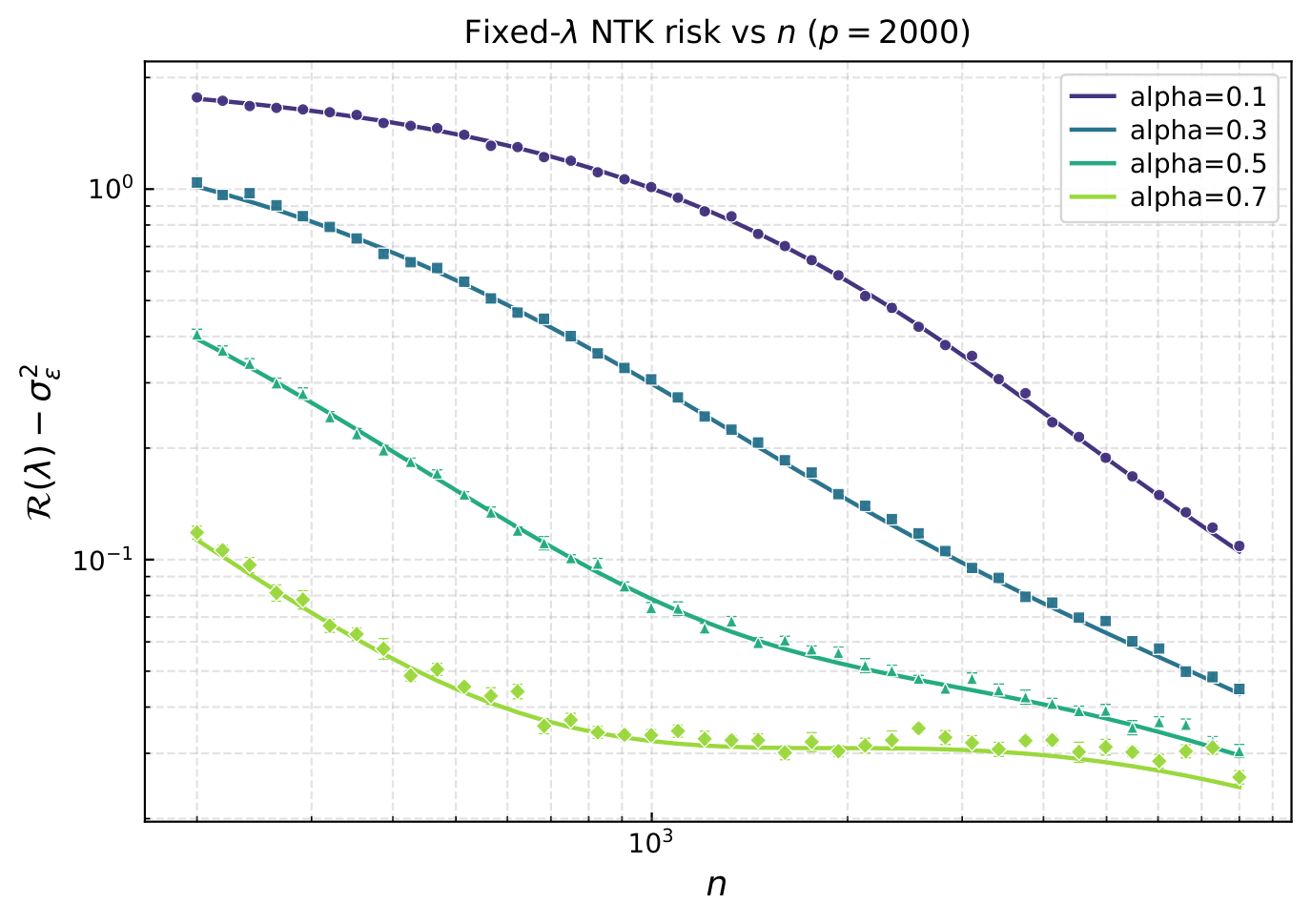
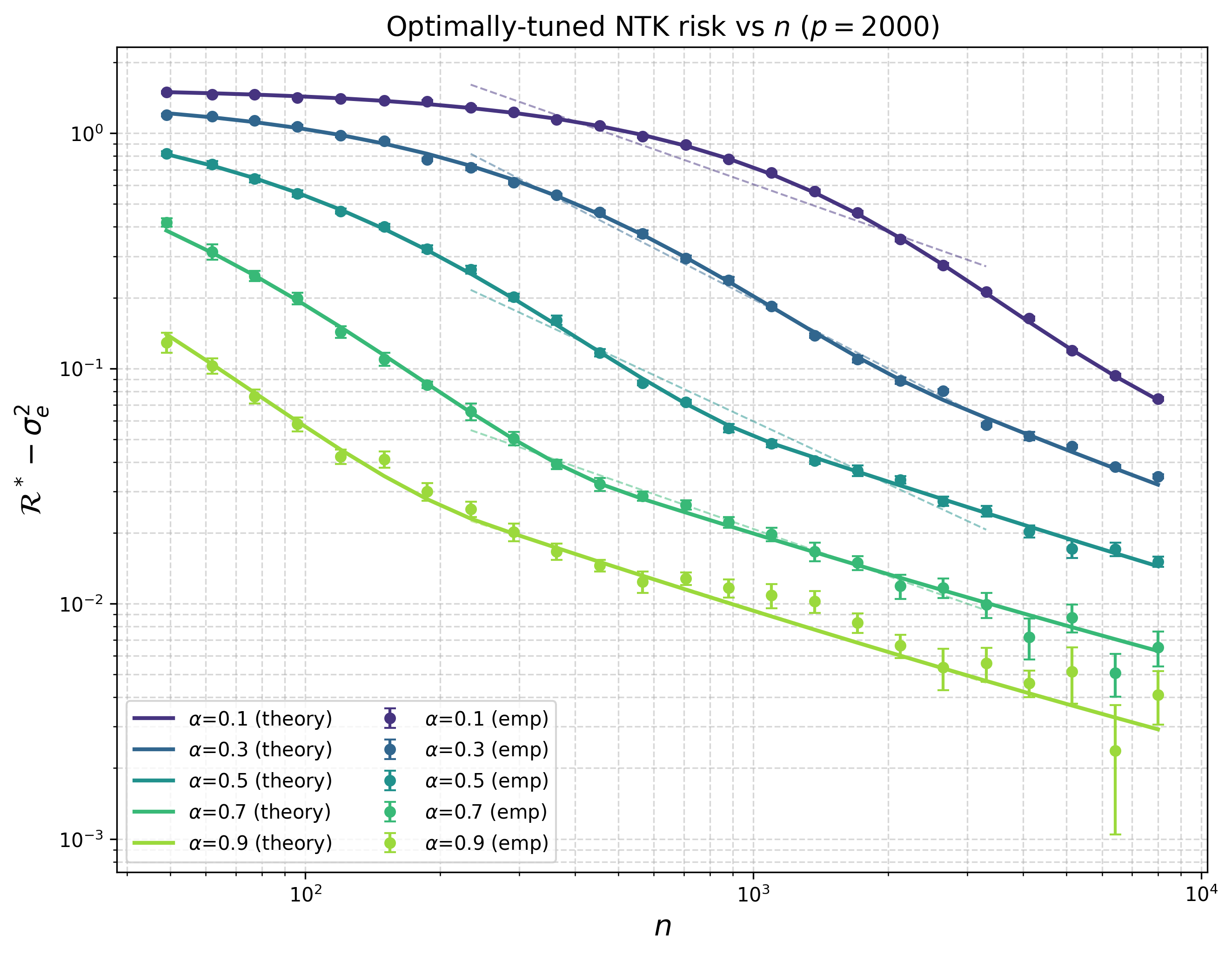
Understanding the generalization behavior of over-parameterized neural networks remains an active and open area of research in deep learning theory. An especially productive line of work proceeds by linearizing the network around its random initialization, leading to the Neural Tangent Kernel (NTK) model. My research focused on theoretical predictions of the performance of NTK regression under general data assumptions, and the development of a new framework to analyze the asymptotic spectral behavior of the NTK under a nonlinearly separable dataset. The following are two plots taken from "NTK Regression under dual power-law model: Deterministic Equivalents via SDE and PDE Methods" (Accepted to NeurIPS 2026), which illustrate the theoretical predictions for the risk of NTK regression for varying spectral decay parameter α.
-
My research can be summarized in three main contributions:
- Deterministic equivalents. Derivation of deterministic equivalents for the prediction risk of NTK regression under a dual power-law model, in which both the training data and label signal exhibit power-law decay.
- Scaling laws. Novel scaling law for the finite-width NTK — helping bridge the gap between theoretical understanding and the empirical neural scaling laws observed in Kaplan et al. (2020) and Hoffmann et al. (2022).
- Spiked models. BBP phase transitions and signal detection for kernels that arise from neural networks under nonlinearly seperable datasets
Papers
-
Accepted to NeurIPS 2026
-
COLT, 2026
-
PhD thesis, UC San Diego, 2026
Experience
Data Science Intern
Built an internal AI agent to automate filing of Cotality's predictive models under state insurance regulations. Used Google ADK to design a graph workflow agent, which grounded answers with RAG (Vertex AI) and MCP servers.
Handshake AI
Worked with top AI labs to create and evaluate novel mathematical tasks that were used to assess and fine-tune performance of large language models (LLMs) in mathematical reasoning.
Graduate Researcher & Teaching Assistant
Advised by Professor Todd Kemp. TA for probability, linear algebra, real analysis, and a summer SLMath course covering deep learning theory, multidimensional scaling, and reinforcement learning.
News
"NTK Regression under dual power-law model: Deterministic Equivalents via SDE and PDE Methods" accepted to NeurIPS (main) 2026!
Data science internship at Cotality working with agentic AI solutions to insurance filings.
Defended my PhD thesis in Mathematics and Statistics at UC San Diego, under the supervision of Professor Todd Kemp.
"Eigen-Spike Emergence and Quadratic Equivalents for Conjugate Kernels on Nonlinearly Separable Data" published at COLT 2026.
Miscellaneous
- languages
- Python, R, SQL, LaTeX
- ml
- PyTorch, scikit-learn, NumPy / SciPy, pandas
- infra
- GCP (BigQuery, GCS), Git, ADK, MCP, RAG
- theory
- Random matrix theory, high-dimensional probability, free probability, deep learning, stochastic calculus